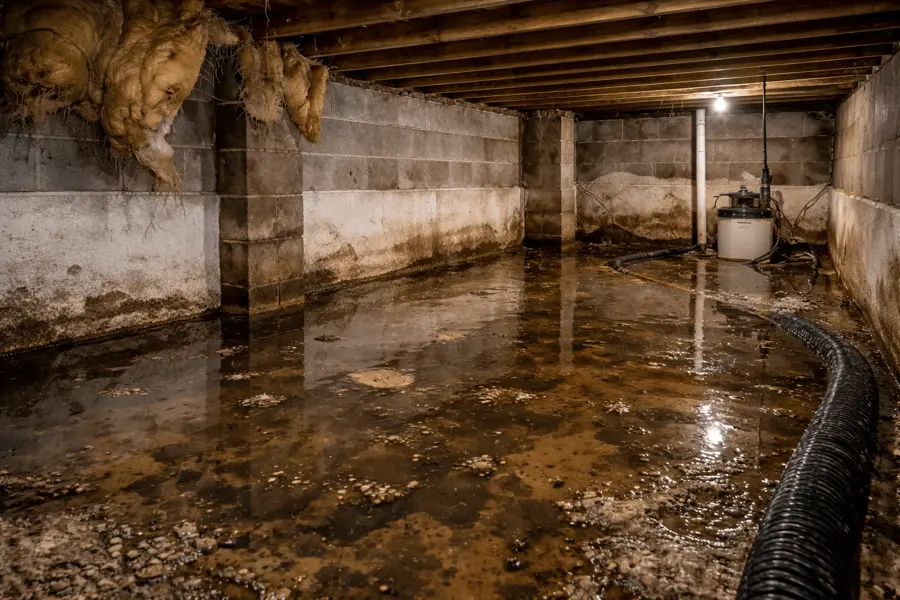
Why Stone Mountain crawl spaces hold water
A lot of the ranch homes around Stone Mountain, Redan and Rockbridge Road sit over vented crawl spaces with block piers on bare red clay. Clay drains slowly, and near the mountain it can be thin over granite, so rain that gets under the house tends to pond instead of soaking away. Inside the crawl space also run the supply lines, the drain lines and on many houses the ductwork, so a failed fitting or a cracked drain drops water straight onto the ground where nobody sees it for days.
- Runoff through foundation vents and low block walls
- Supply line and polybutylene leaks
- Cracked or separated drain lines
- Air handler and duct condensation in humid summers
How the crawl space is cleaned up and dried
The extraction crew pumps standing water out and pulls pooled water off the vapor barrier. Soaked fiberglass insulation between the joists holds water against the subfloor, so it comes out. If the water came from a drain line or outside, it is Category 3: the crew wears protective gear, removes contaminated debris and applies an EPA-registered antimicrobial. The drying team then sets air movers and dehumidifiers under the house and closes the space up enough to control the air, taking readings on joists and subfloor every day.
High crawl space humidity shows up upstairs as cupping hardwood, sticking doors and a musty smell. Drying the crawl space often fixes all three.
Keeping it dry afterward
A continuous vapor barrier, working gutters and downspouts carried away from the foundation, and graded soil that slopes away from the house handle most runoff. Some homes need a crawl space drain and sump. UGA Extension covers moisture control for Georgia homes, and the Department of Energy explains crawl space insulation choices. For related losses see frozen pipe cleanup and structural drying.