Standing water, pulled out fast

Water Extraction in Stone Mountain, GA

Every hour standing water sits, more of it wicks into drywall, subfloor and the red clay under a crawl space. The extraction crew pulls it out with truck-mounted power first, then the drying team takes over.

(888) 532-4616Pull the standing water out of the house tonight
Emergency dispatch, day or night Dried to IICRC S500 Moisture readings every day
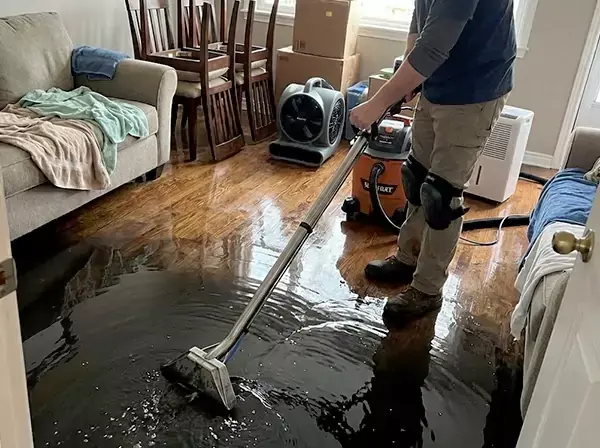
Extraction wand pulling standing water off a flooded hardwood living room floor
Loss profile
First moveExtraction before drying
EquipmentTruck-mounted and portable units
StandardIICRC S500 drying goal
Dispatch24/7 around the mountain
First steps

What to do the moment you find standing water

  1. 1
    Stop the source

    Close the main shutoff or the fixture valve if the water is coming from plumbing. Leave storm water to the pros.

  2. 2
    Power off wet circuits

    Switch off breakers for rooms with water on the floor if the panel itself is dry. Stay out of water near outlets.

  3. 3
    Photograph first

    Photograph the water line on walls and furniture before anything moves. Those photos start the claim file.

  4. 4
    Lift and call

    Lift rugs, cushions and boxes off the floor, then call. Extraction removes far more water than any amount of drying.

The process, layer by layer

How water extraction is handled in Stone Mountain, GA

Every Stone Mountain job runs in the same order, because the order is what separates a finished dry-out from a cosmetic one.

  1. 1

    Map the moisture

    The tech who does the walkthrough finds the source and maps wet materials with thermal imaging and pinless meters before any equipment goes down.

  2. 2

    Extract

    The extraction crew pulls standing water with truck-mounted or portable extraction, so the water leaves the building instead of wicking into the next room.

  3. 3

    Set the drying

    The drying team sizes air movers to each room's evaporation load and runs LGR dehumidifiers, with desiccants for dense materials and cool crawl spaces.

  4. 4

    Read it daily

    Readings go into the drying log every day, and equipment moves to whatever is still wet.

  5. 5

    Verify and document

    Equipment comes out when the wet material sits within 2 to 4 points of a dry reference, and the logs go into the claim file.

Typical cost ranges

What does water extraction cost in Stone Mountain, GA?

In Stone Mountain, GA, water extraction on its own typically runs $400 to $2,500. One room of clean water sits at the low end; a flooded daylight basement with carpet and pad sits at the high end. Drying and any removal are priced on top.

One room

$400 to $900
  • Clean water, hard floors or carpet
  • Truck-mounted extraction
  • Moisture check of the edges

Several rooms or a basement

$900 to $1,800
  • Carpet and pad extraction
  • Weighted tools for pad
  • Moisture mapping

Deep or contaminated water

$1,800 to $2,500+
  • Submersible pumps first
  • Category 2 or 3 handling
  • Protective gear and disposal

The drivers are the water category, the square footage that got wet, the material class (drywall and carpet versus plaster, hardwood and block) and how fast drying started. For a planning number, try the Stone Mountain water damage cost calculator.

Why extraction comes before everything else

Extraction is the cheapest drying there is. A truck-mounted unit pulls hundreds of gallons out of carpet, pad and hard floors in the time a room of fans would evaporate a few buckets. Every gallon the extraction crew removes as liquid is a gallon the dehumidifiers never have to pull out of the air, so the job dries faster and more material stays in place. In Stone Mountain that matters twice: split-level and basement homes let water run downhill into the lower level, and ranch homes over crawl spaces let it drain through the subfloor into the clay below.

  • Truck-mounted extraction for large, clean-water losses
  • Portable units for upper floors, condos and tight access
  • Weighted extraction tools that squeeze water out of carpet pad
  • Submersible pumps when water stands more than an inch or two deep

What the extraction crew checks while the water comes out

The tech who does the walkthrough maps moisture with thermal imaging and pinless meters while the extraction runs, because water from a single source travels under baseboards, into wall cavities and along subfloor seams far from where it pooled. Carpet pad that held Category 1 water can often stay; pad that sat in Category 2 or 3 water comes out. Hardwood gets extracted with floor mats before it cups. Details are on the structural drying page, and flooded lower levels are covered on basement flooding cleanup.

A household wet vacuum holds a few gallons. A soaked 12 by 14 foot room of carpet and pad can hold well over a hundred. That gap is why extraction is a truck job.

Storm water and sewage need a different plan

Water that came in from outside during a thunderstorm, from Stone Mountain Creek or from a sewer line is Category 3 the moment it arrives. The extraction crew wears protective gear, removes porous materials it touched and applies an EPA-registered antimicrobial after the water is out. See storm flood cleanup and sewage backup cleanup for those losses. Ready.gov flood safety covers staying safe around electrical hazards before the pros are inside.

For planning, the National Weather Service office in Peachtree City issues the flash flood warnings for DeKalb County, and a warning is a good time to move valuables off basement floors.

Service area

Water extraction across Stone Mountain and nearby DeKalb County

Stone Mountain, GA and the Stone Mountain ZIP codes around the mountain

The Stone Mountain restoration crew handles water extraction in all four Stone Mountain ZIP codes, 30083, 30086, 30087 and 30088, from the village on Main Street out to Redan, Smoke Rise and Rockbridge Road.

The same crews cover Tucker, Clarkston, Pine Lake, Lithonia, Stonecrest, Snellville and Lilburn.

See every Stone Mountain area and ZIP

Questions

Water Extraction questions in Stone Mountain, GA

How fast should standing water be extracted?

As soon as possible. Water keeps wicking into drywall and subfloor, and mold can start inside 24 to 48 hours, so extraction is the first step on any emergency water call.

Can wet carpet be saved after extraction?

Often yes if the water was clean and extraction and drying started quickly. Pad usually costs little to replace and is swapped when it held gray or black water.

Is a shop vacuum enough?

For a small spill, maybe. For a soaked room it removes a fraction of the water, and the rest keeps spreading into the structure.

Does insurance cover water extraction?

Extraction after a sudden and accidental loss, such as a burst supply line, is commonly part of a covered claim after the deductible. Coverage depends on your policy, so it is worth checking with your own insurer.

What happens after the water is out?

Air movers and LGR dehumidifiers go in, sized to each room, and readings are taken every day until materials reach the drying goal.

Why does storm water get handled differently?

Surface water is Category 3. Porous materials it touched are removed, not dried, and hard surfaces are treated with an EPA-registered antimicrobial.

Emergency water removal

Standing water in Stone Mountain? Call now.

Truck-mounted extraction first, then structural drying and a documented dry-out.

(888) 532-4616Start the Stone Mountain water removal
Call (888) 532-4616 24/7