Dry by the readings, not the calendar

Structural Drying in Stone Mountain, GA

Surfaces dry in a day; framing, subfloor, hardwood and block do not. The drying team maps the moisture, sizes the equipment to each room and keeps it running until the readings match a dry reference, then documents it.

(888) 532-4616Dry the framing and subfloor to standard
Emergency dispatch, day or night Dried to IICRC S500 Moisture readings every day
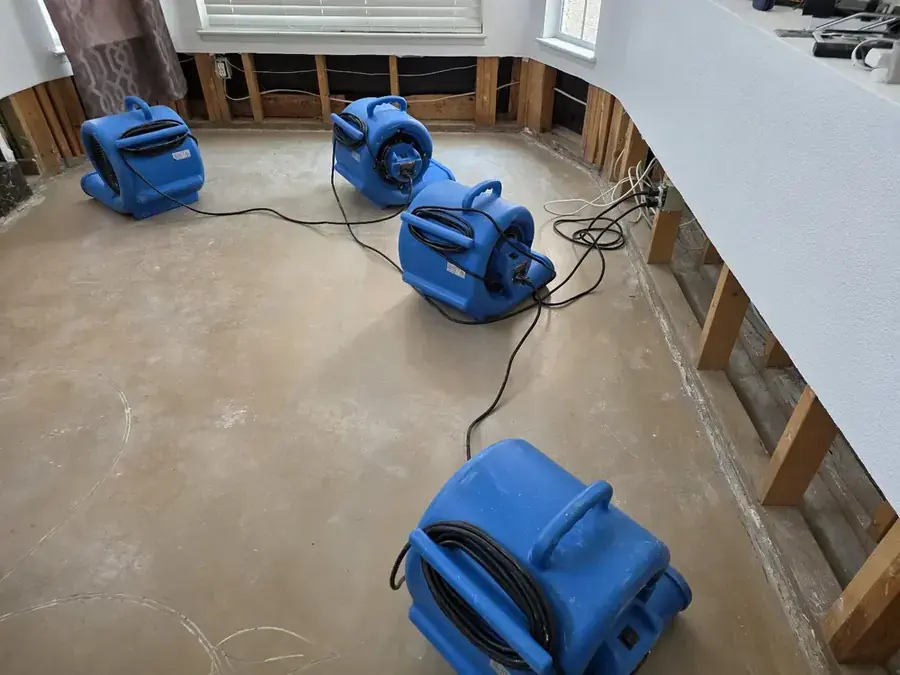
Air movers drying a stripped room after the lower drywall was removed
Loss profile
StandardIICRC S500
ToolsMeters, thermal imaging, LGR, desiccant
Finish line2 to 4 points of dry reference
Dispatch24/7 in Stone Mountain
First steps

What to do the moment you find water in walls and floors

  1. 1
    Stop the water

    Stop the source or get it stopped. Drying cannot start while water is still coming in.

  2. 2
    Get the standing water out

    Extraction first. Every gallon removed as liquid saves days of drying.

  3. 3
    Open up the air

    Turn on the air conditioning in summer and open closet and cabinet doors so wet areas can breathe.

  4. 4
    Call before it settles in

    Water moves from surfaces into framing and subfloor quickly. The sooner drying starts, the less comes out.

The process, layer by layer

How structural drying is handled in Stone Mountain, GA

Every Stone Mountain job runs in the same order, because the order is what separates a finished dry-out from a cosmetic one.

  1. 1

    Map the moisture

    The tech who does the walkthrough finds the source and maps wet materials with thermal imaging and pinless meters before any equipment goes down.

  2. 2

    Extract

    The extraction crew pulls standing water with truck-mounted or portable extraction, so the water leaves the building instead of wicking into the next room.

  3. 3

    Set the drying

    The drying team sizes air movers to each room's evaporation load and runs LGR dehumidifiers, with desiccants for dense materials and cool crawl spaces.

  4. 4

    Read it daily

    Readings go into the drying log every day, and equipment moves to whatever is still wet.

  5. 5

    Verify and document

    Equipment comes out when the wet material sits within 2 to 4 points of a dry reference, and the logs go into the claim file.

Typical cost ranges

What does structural drying cost in Stone Mountain, GA?

In Stone Mountain, GA, structural drying typically runs $1,000 to $8,000, driven mostly by how many rooms are wet, the material class and how many days the equipment runs. Hardwood, plaster and crawl spaces sit at the high end.

One or two rooms

$1,000 to $2,500
  • Air movers and one dehumidifier
  • Daily readings
  • Drying log

Several rooms or a level

$2,500 to $5,000
  • Multiple dehumidifiers
  • Cavity drying
  • Moisture mapping

Class 4 materials

$5,000 to $8,000+
  • Hardwood mats or desiccants
  • Longer run time
  • Full documentation

The drivers are the water category, the square footage that got wet, the material class (drywall and carpet versus plaster, hardwood and block) and how fast drying started. For a planning number, try the Stone Mountain water damage cost calculator.

What structural drying actually means

Structural drying is drying the building, not just the surfaces. After a water loss, water soaks into drywall, the bottom plates of walls, subfloor, hardwood, concrete and block. The surface can feel dry in a day while the material underneath stays wet enough to support microbial growth and warp floors. IICRC S500, the industry drying standard, sets out how to classify a loss, how much equipment it needs and how to prove the building is dry.

  • Category 1, 2 and 3 water are handled differently
  • Class 1 through 4 sets how much equipment a room needs
  • Air movers set to the room's evaporation load
  • LGR dehumidifiers for most losses, desiccants for Class 4 materials

How the drying team runs a job

The tech who does the walkthrough maps moisture before any equipment goes down, using thermal imaging to find wet areas and pinless and pin meters to measure them. A dry reference, a matching material in an unaffected part of the house, sets the goal. The drying team places air movers along wet walls and floors, pairs them with dehumidifiers sized to the air volume, and injects air into wall cavities and under cabinets where needed. Hardwood gets floor drying mats. Readings go into the drying log every day, and equipment moves as areas dry.

The finish line is a number, not a date: the wet material within 2 to 4 points of the dry reference. Equipment stays until the readings say dry.

Why Stone Mountain homes dry differently

Humid Georgia summers make dehumidification the key to the whole job; opening windows usually adds moisture instead of removing it. Crawl spaces over red clay and cool daylight basements slow evaporation, and 1970s and 1980s homes often have hardwood under carpet that needs its own drying. EPA indoor air quality guidance explains why wet materials should be dried within 24 to 48 hours, and UGA Extension covers humidity control in Georgia homes. See crawl space water removal and water extraction for the steps that come first.

Service area

Structural drying across Stone Mountain and nearby DeKalb County

Stone Mountain, GA and the Stone Mountain ZIP codes around the mountain

The Stone Mountain restoration crew handles structural drying in all four Stone Mountain ZIP codes, 30083, 30086, 30087 and 30088, from the village on Main Street out to Redan, Smoke Rise and Rockbridge Road.

The same crews cover Tucker, Clarkston, Pine Lake, Lithonia, Stonecrest, Snellville and Lilburn.

See every Stone Mountain area and ZIP

Questions

Structural Drying questions in Stone Mountain, GA

How long does structural drying take?

A contained Class 1 or 2 loss usually dries in three to five days. Hardwood, plaster, block and crawl spaces take longer.

Why not just open the windows?

In Stone Mountain's humid air, open windows often add moisture. Closed rooms with dehumidifiers dry faster and more predictably.

What is a dry reference?

A matching material in an unaffected part of the house. Wet materials are dry when they read within 2 to 4 points of it.

Can the equipment be turned off at night?

It should run continuously. Turning it off lets moisture settle back into materials and adds days to the job.

Does insurance pay for drying equipment?

Drying after a covered sudden loss is commonly part of the claim, supported by the daily logs. Coverage depends on your policy, so it is worth checking with your own insurer.

What is Class 4 drying?

Class 4 covers dense materials like hardwood, plaster and concrete that hold water deeply and need specialty drying such as desiccants and floor mats.

Emergency water removal

Need a real dry-out in Stone Mountain?

Moisture mapping, sized equipment and daily readings to the IICRC S500 goal.

(888) 532-4616Start the Stone Mountain dry-out today
Call (888) 532-4616 24/7